NGT – What happens to the Trees on the A660 green corridor?

There is no official information on the height of the catenary system, that supports the cables of the NGT trolley bus scheme. Unlike continental trolley buses, the system has to be of an unusual height because double-decker buses will travel under it for many sections of the route. The mast height of 6.5metres (about 20 feet) is my “guestimate” as safe clearance for a 4.3 metre bus is required. The power line will carry about 700 volts.

The design and build must allow for all conditions. Engineers will have in mind extreme conditions such as a winter gale.

The design of the route will acknowledge that no tree or branch can lean over this catenary system. There can be no circumstances where a branch can be allowed to touch the masts, cables or braces. Re-growth of a brashed (cut back) tree will not be permitted. The best method of ensuring safety and line continuity is to remove the tree because continuous maintenance will be difficult. An extensive tree removal programme will threaten our green corridor, from Monument Moor to beyond the Lawnswood roundabout. When you next travel along the route look up and estimate the lean of the branches over the A660 to get an idea of which trees will be removed. It looks like a very large number.

The gantry system on a catenary system – Environmental and Aesthetic impact

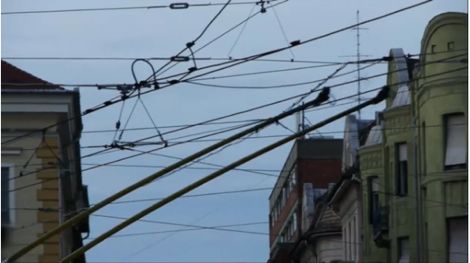
There are many examples on the web of what a trolley bus support system looks like. The drawings on the NGT website indicate little and give no measurements. The diagram above shows what it could, and probably will, be like. There is no hard information from the proposers of the NGT. The dimensions here are calculated on the height to accommodate a double-decker bus. The cute diagrams of traffic-free streets and gossamer cabling systems on the NGT website bear no relationship to the engineering and safety requirements and their visual impact.

The probable height of the catenary system to accommodate double-decker buses on the route of the NGT

There are very few single deck trolley bus systems that share the route with double-decker buses. Single-decked trolley bus routes tend to be designed for special routes not shared with high-sided vehicles. The NGT shares many parts of its route with double-decker buses. The diagram above shows the problem. It creates a very high catenary system. Double-decker buses raise the roof on the engineering. The heights above are researched but are estimates only. The power cables in the catenary system will carry up to 700 volts. So there won’t be any open-topped buses in the unlikely event of Leeds United winning a trophy anywhere near the NGT system.

It is very hard to get detailed information on the NGT Leeds scheme. There is none given on the NGT website except unrealistic pictures which are just a marketing exercise. The information I have given is based on other schemes, all of which use slightly different constructions of their catenary system.

Calls for an underground

Photo courtesy of Adam E Moreira

The Yorkshire Evening Post has recently published several letters calling for Leeds to have an underground system.

To those who think an underground system would be too expensive, Janet Bailey points out that tunneling is cheaper now than it used to be. Hannah Johnson points out that other European cities are building underground systems whilst Leeds gets left behind. D Birch says that private companies should be invited to provide us with an underground system. Terry Allinson says there should be an underground link between Leeds and Bradford. And George Horsman informs us that back in the 1930s, Leeds City Council had detailed plans for building an underground system.

Leeds residents condemn NGT

The Yorkshire Evening Post has published several letters recently that criticise the NGT trolleybus scheme.

There were letters from Bill McKinnon and Dawn Carey Jones who are concerned about the plan to route the trolleybuses across a section of Woodhouse Moor. Andrew Batty points out that the trolleybuses will be bendybuses with wires, and that bendybuses have been scrapped elsewhere because they are cumbersome and unpopular. Peter Brash makes it clear that trolleybuses will just add to congestion. Kim Cowell relates how Transport for London ruled out the use of trolleybuses in London on the grounds of inefficiency and cost. Sarah Sullivan reveals that the Department of Transport estimate that the NGT trolleybus scheme will cost Leeds businesses in excess of £200 million.

NGT and Metro’s obsession with trolleybuses

An earlier incarnation of NGT was the failed Electrobus scheme of the 1980s. Metro’s original intention in 1980 had been to re-introduce trolleybuses to Bradford. But after two failed attempts to secure government funding, Leeds was included in the scheme, in the hope that this would persuade the government to change its mind.

But the government refused funding again on the ground that the trolleybus would only be economic if it had no competition.

Metro decided to go ahead anyway. But then in 1990, when an independent bus company announced plans to set up a rival bus service along the proposed first trolleybus route in Bradford, Metro withdrew its plan. It had taken them 10 wasted years to finally accept that trolleybuses couldn’t compete economically with diesel buses, the very same reason that trolleybuses were originally withdrawn from service.

NGT – The Vehicle Stacking System on Woodhouse Moor

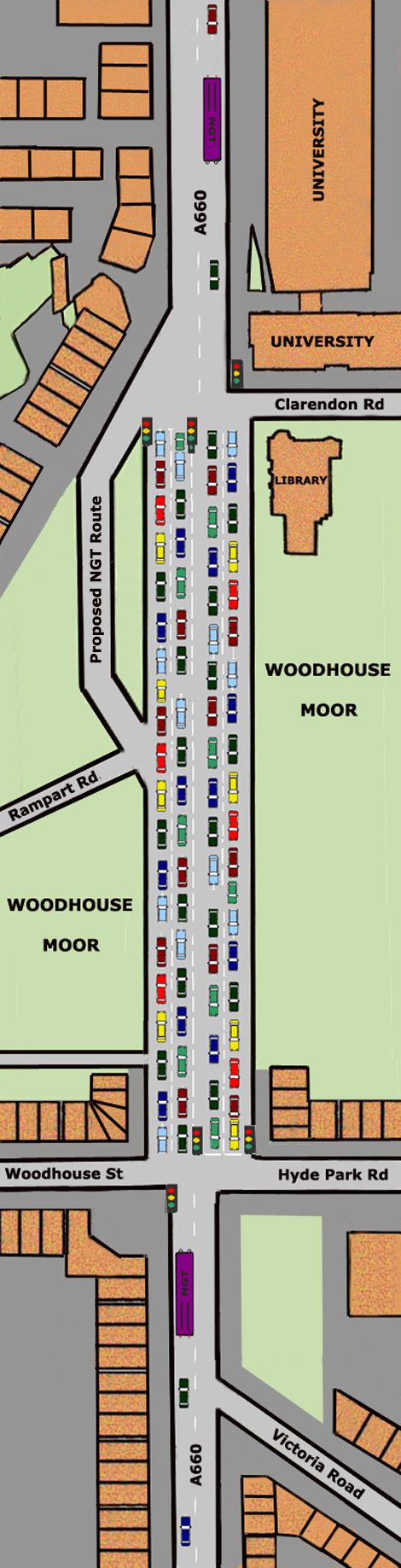
The traffic queues that daily stretch all the way from Headingley Hill to Hyde Park Corner are soon to become a thing of the past. And the jam that stretches from the city centre to the junction with Clarendon Road is also to be consigned to history.

The highways engineers behind NGT have come up with a scheme which will transfer both traffic jams onto the stretch of the A660 that crosses Woodhouse Moor. Currently this is a dual carriageway where traffic flows freely. And as a dual carriageway, it is much wider than the stretches of the A660 to either side of it which daily become jammed with traffic. By cleverly progamming the traffic lights on the the A660, the highways engineers hope to get traffic quickly off the narrower stretches of road, and onto Woodhouse Moor using what is known as a “vehicle stacking system.” By this means, the trolley bus will be able to travel more quickly along the narrower stretches of road to ether side of Woodhouse Moor.

It’s a sad indictment of Leeds City Council that it’s prepared to exploit an inner city park and expose its users, including families with young children, and students, to the emissions produced by stacked traffic.

The emissions produced by stacked traffic.

NGT – Woodhouse Moor to be sacrificed so motorists won’t be held up


Annn article in the Yorkshire Evening Post informs us that the NGT trolleybus
An article in the Yorkshire Evening Post
informs us that the NGT trolleybus scheme has been given the green light, but fails to mention that the proposed route will take it across Woodhouse Moor. The original idea behind NGT was to get people out of their cars and onto public transport. But somewhere along the line, the planners have lost sight of that. Incredibly, the reason they want NGT to run across the Moor, is so that inbound motorists won’t be held up by the trolleybus at the junction of Woodhouse Lane with Clarendon Road. Don’t they realise that if motorists are held up by the trolleybus at this junction, that’s just the incentive they need to get them out of their cars and onto the bus? Woodhouse Moor is the only one of our inner city moors to have escaped the motorway building frenzy of the sixties and seventies. Now it too is to be sacrificed to the motor car.

NGT trolley bus – another daft idea

The proposed NGT trolley bus for Leeds does not decrease carbon dioxide pollution; it just delocalises it away back to a coal fired power station. The transmission losses actually increase carbon dioxide pollution. It will do less than buses do as it can’t be deployed for school runs, specials, and can’t be used off its wires. It only covers a small part of the city. Bus lanes and cycle lanes will be removed. Mature trees dug up, Yorkshire stone walls removed and more concrete installed at junctions. The private companies that build and run it will make a fortune out of the initial public investment of £250+ million.

Only a deprivatised, locally controlled, cheap, integrated transport system will make a dfference to our mad, congested car culture.

The NGT has attracted much adverse comment in the YEP. An extract is given below:

“Wow! Buses on wires! I can barely cope with the excitement. It’ll be like riding on a bus. With wires!

We’ll be able to look up to the sky, and see wire after wire. I liked the wire, so I’m all for it! It’ll only cost the GDP of a small country, and I like buses too!”

We need more urban railway stations. There are six that could be rebuilt now. There are regional rail lines that could be restored such as the Wetherby line. Leeds should spend the £250 million as it sees fit and ignore this central Government publicity stunt. Its just an election promise which will just be cancelled in a few years time.

A large white elephant would be the most suitable logo for this scheme.